Adult only. Private by design.
What a key party was, and what it is now

Key party history is the story people already half know: keys in a bowl, a living room, and a partner named by chance. The 1970s key party is usually told that way. Guests chose to be there. The draw did not ask who wanted whom. A modern key party keeps the mystery, and mutual yeses are revealed together.
The short version
Key party meaning splits in two, and it helps to say which one you mean. The old meaning is a party game people describe from the 1970s: car keys in a bowl, a draw, and a partner for the rest of the night. The new meaning is an invited adult night with the same sense of occasion, and a different way of choosing.
In the familiar story, showing up was the yes. You came, you tossed a key in, and you lived with whatever came out. That is an implied, all-in opt-in. It is a yes to the game. It is not a private yes to one particular person. Chance did the pairing. If the result felt wrong, the room was already watching.
The modern night keeps the invited room, the small ceremony, and the moment when everyone looks up together. The choice moves earlier, and it stays private. A no is never shown. No one is paired with someone they did not pick.
If you want the short definition without the history, start there. This page stays on the older story, and on what a host can keep without keeping the lottery.
The picture people already have
Most people who flinch at the phrase are reacting to a picture, not to a night they attended. The picture is vivid. The record behind it is not.
The bowl, the keys, the living room
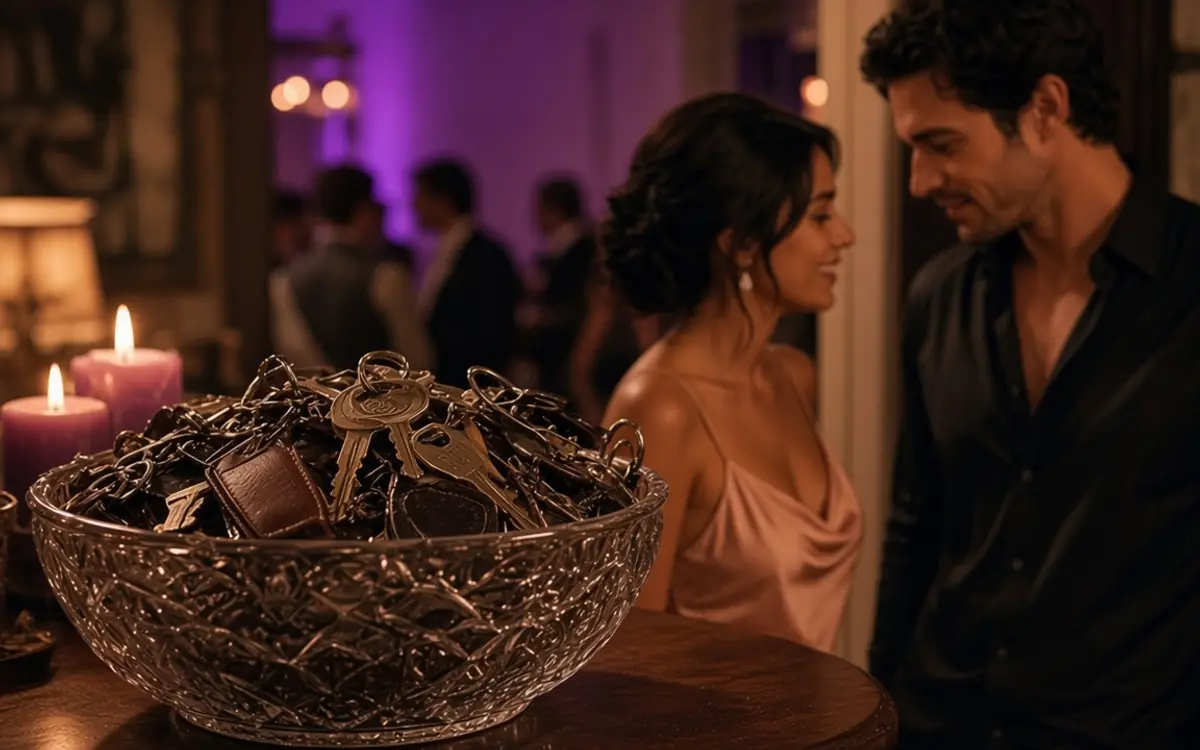
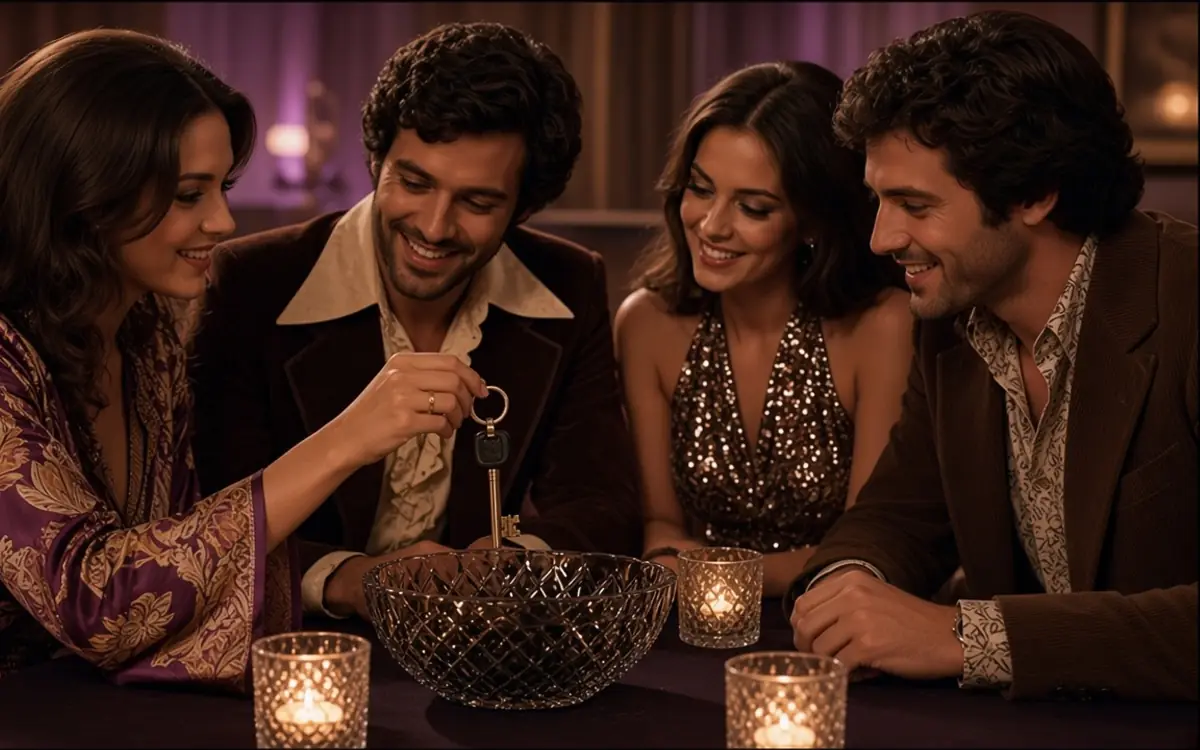
Ask someone who has only heard the phrase, and they will usually describe a suburban living room. Couples arrive. A bowl sits on a table. Someone drops in a car key. Later someone draws. The owner of that key is the partner until morning, or until the hosts say the game is done.
One key often stood for a couple, not for one person. The token on the table could commit two people at once. The partner who hated the result had already been spoken for by a key they may not have dropped. Popular tellings disagree about who dropped the keys and who drew them. Some say the women draw. Some say every couple brings one key and the draw is the whole evening. Some say the bowl comes out late, after dinner, as a dare. Those are variations on a legend. They are not a rulebook.
In the telling, the keys are usually car keys, because a car key is easy to recognize. A house key or a tagged token shows up in other retellings. Either way, the object stands in for a person, and the bowl hides whose it is until the draw.
Why that picture sticks
The picture sticks because it is simple: a planned party, a small guest list, a little ceremony, and a partner you did not pick in the ordinary way. Films, television, and jokes have repeated it until it feels like a memory even for people who were not there. Repetition is not a record. It does explain the wince, and the grin, before anyone has described an actual night.
People who like the modern night are often chasing the secrecy and the shared gasp, not the lottery. Naming that honestly is how you keep it. Pretending the bowl was mutual choice is how you lose the people who already do not trust the phrase.
What we can actually say about the 1970s
The 1970s key party is a story our culture tells with confidence. The documented part is thinner. This section stays inside what the usual telling supports, and it labels the rest as legend.
An implied yes, then chance
What we can say, carefully, is about the story as it is usually told. People chose to attend. In the familiar version they also chose to put a key in the bowl. That is a yes to the game. It is not a private yes to every person who might draw them, with a no that costs nothing to give.
After that yes, the pairing was chance. The bowl does not know who finds whom attractive, who is tired, or who came to keep a partner company and hoped the draw would be kind. Once the key is out, declining means doing it in front of the people who just watched it land. Some guests in these stories smile through a match they did not want, because a public no feels ruder than a bad yes. That is manners under pressure. It is not the same thing as wanting the person.
Do not read the 1970s version as an early design for consent. Consent, on the night we host now, is a yes you can withhold without putting on a show. The old draw, as people describe it, did not work that way. That is not an insult to everyone who ever went. Plenty of people remember nights they chose, with friends they liked, and a result they were glad to get. The mechanism still left the awkward cases to luck and to nerve.
Where the record gets thin
Here is the line between legend and what is documented. The key party is widely described and thinly pinned down. Popular culture treats it as a fact of the era. A closer look mostly finds the same picture repeated: a bowl, keys, a suburb, the 1970s.
What those sources do not settle is the part people argue about. How common it was. Whether guests at the time used the name key party, or whether that name settled in later. Who dropped keys. Who drew. Whether the draw was the whole night, or a story about a night that was mostly dinner, dancing, and flirting. A memoir is still one person's memory. A film that stages the bowl is staging a picture audiences were expected to recognize. A history that mentions the game in passing is often handing on the anecdote, not auditing it.
Read the sources as what they are. Period newspaper and magazine pieces, when you can find them, sit closer to the era than a joke on a sitcom. University-press histories of the sexual revolution and of swinging sometimes mention the key party, and the careful ones mark it as an anecdote rather than a counted practice. A memoir can tell you how a night felt to the person who wrote it. It cannot tell you the night was typical. None of those, on their own, hand you a headcount, a standard rulebook, or a sentence you should treat as official.
What to cite, and what not to pretend
Cite a scene as a scene. A movie with keys in a bowl shows what filmmakers thought audiences would recognize. It does not show one particular living room. Cite a memoir as a memoir. When a historian is retelling a widely repeated story, leave it as a retelling. Do not upgrade it into a number.
What not to pretend: that we know how large a share of couples did this, that we know the season it started, that we know a famous sentence said over the bowl, or that the old party was secretly mutual choice with better manners than it looks. Those claims make the story neater than the record. Key party history can stay a little murky. The modern night does not need a fake pedigree.
What felt unfair, even when everyone came on purpose
People flinch at the phrase for reasons that deserve a straight answer. In the story they have heard, you can do everything asked of you and still be handed someone you would not have chosen. You can watch your partner get handed someone, too, while the room waits for you to be a good sport. That is a hard spot, even if you drove there on purpose and put a key in with your own hand.
The unfairness is not that adults played. The unfairness is that the familiar mechanism makes a no expensive. A private no is quiet. A no after a public draw is a scene. Couples feel that more sharply, because one key often stood for both of them. One person can be curious and the other done for the night, and the bowl cannot hear the difference. Nobody wants to be the key that soured the mood, or the person who had to perform delight.
If that is why you dislike the phrase, you heard the part of the legend that was careless with people. A modern key party answers that part. It is not a speech about how the 1970s should have felt, and it is not a claim that every old story ended badly. The mystery can stay. The pressure to swallow a bad draw does not have to.
What a modern key party keeps
A modern key party keeps the parts people were actually hungry for. The host invites friends they'd love to have there. The night has a shape and a reveal, so it feels like an occasion. There is still mystery, because you do not walk in already holding a name. The room still finds out together.
The people in the room are the people the host wanted there. The surprise is which mutual yes opens. You can like your friends and still want the evening to turn. That want is allowed. It does not get to run over a no.
House rules stay the host's. Dress, phones, which rooms are off limits, and what a no means in that house belong in the invite, in the host's own words. Guests should hear them before they pack a bag.
What it changes
The bowl picked a person at random and made the room witness it. The modern night asks first, in private, and only then lets the room look up.
A private pick before the party
Before the party, everyone privately picks who they would like to play with, or not. The pick is about a person, not a key that stands for a couple. Your own partner is never a card. A no stays hidden. The person you passed does not get a notice, and the room does not get a chart of who declined whom.
A match needs a yes in both directions. A one-sided yes is not a consolation prize. You can change an answer until the picks lock. After that, the reveal uses the answers people gave. No one is paired with someone they did not pick. The bowl could not say that. This night can.
One reveal, for the whole room
At the party, everyone sees their pair at the same time. The host opens that moment. Each guest sees one Play Partner: one photo and one name. The line on the card is a mutual yes. The room does not get a wall of every match. If there is another round, it is still one person.
You still get the look up, and a name you did not announce ahead of time. You do not get a public drawing of someone who already said no. Mutual yeses are revealed. The nos never become the entertainment.
The product page has the door, the address, and the rest. This page only needs the change you can feel: private choice first, shared surprise second.
How the night runs
Three beats are enough to see the shape. The rest is hosting, and it lives on the product page.
- The host invites friends they'd love to have there.
- Before the party, you privately pick who you would like to play with, or not. A no is never shown.
- At the party, everyone sees their pair at the same time. Mutual yeses are revealed. You get one Play Partner: one photo and one name.
A play party is a different night. Mutual matches are revealed when the host checks that guest in. There is no room-wide Round 1, and no single Play Partner for the whole room. One name and a shared gasp is a key party. Moving through the mutual yeses is a play party.
The bowl was the old picture. The night worth hosting is the one where the mystery stays and the choice is yours. Host a key party, or open the invite a host already sent you.
FAQ
Did 1970s key parties really use a bowl of car keys?
That is the usual telling: car keys in a bowl, a draw, and a partner named by chance. Films and jokes repeat it. How often it happened, and whether every night matched that picture, is much less settled. Treat the bowl as the legend people recognize, not as a verified set of house rules.
Was the old key party mutual?
Not in the way we use that word now. Guests in the familiar story opted in by showing up and putting a key in. That is a yes to the game, not a private yes to a particular person that the other person returned. Who you ended up with was chance. A no, if you managed one, happened in front of the room.
Why do people flinch at the phrase?
Because the story they have heard can be careless with people. A public draw makes a no expensive. One key often stood for a couple, so both partners could be committed by a token. That reaction is reasonable. It is also why the modern night does not use the bowl.
What is the modern version, in one breath?
An invited night. Before the party, you privately pick who you would like to play with, or not. A no is never shown. At the party, everyone sees their pair at the same time, and mutual yeses are revealed. One Play Partner: one photo and one name.
Do you still get the surprise?
Yes. You do not walk in already holding the name. The room looks up together when the host opens the reveal. The surprise is a mutual yes, not a lottery. You are not paired with someone you did not pick.
What if I do not want to play with someone there?
Say no in private before the party. That no is never shown. You will not be paired with them. If you would rather sit the night out entirely, tell the host. That is a complete answer. You do not owe the room a speech.
Is this the same as a play party?
No. A key party reveals one Play Partner, and the room sees pairs at the same time. A play party has no pairing round. Mutual matches open when the host checks that guest in. Both nights start from a host who invites friends they'd love to have there. The reveal is what changes.